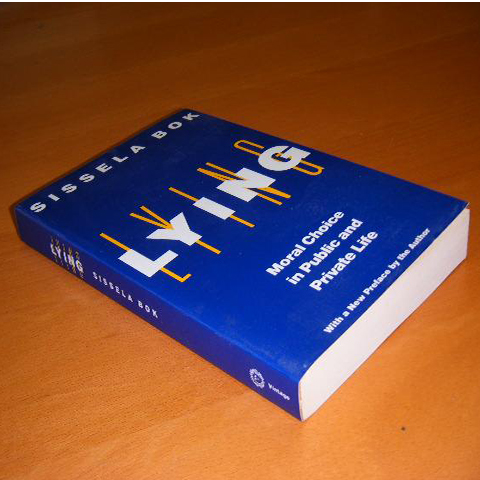
Lying: Moral Choice in Public and Private Life, by Sissela Bok is the single most influential and groundbreaking piece of literature on the subject of lying. This book explores the ethics of lying, motivations for lying, and in which scenarios that lying is justified.
If we are being truly honest with ourselves, we can accept that lying is one of most common wrong acts that we commit on a daily basis. From early childhood, well into adulthood, a person will lie thousands of time. There are many reasons why a person lies: they could be exaggerating a “fishing story,” covering up a misdeed or wrongdoing, failing to keep a commitment, trying to make sure they don’t hurt someone else’s feelings, or even intentionally trying to inflict harm on another. Thus we see, lying is simply a part of life and we must accept the fact that we are all liars. This is why it is important to understand the very act of lying at its core.
In her book, Bok defines a lie as, “an intentionally deceptive message in the form of a statement” (636-637). Upon concluding my study of this book, I have come to accept any lie that one may attempt to justify and deem necessary should be studied through multiple scopes: the perspectives of the parties being involved, the principle of veracity, the doctrine of utilitarianism, and the intent of the lie in question. Bok takes time to explain the rational for each of these scopes, while leading us through an exploration of lying and the role it plays in society.
Perspectives on Lying
The act of a lie is simple. It simply boils down to someone intentionally delivering a deceptive message to another. The effects of a lie, however, are impossible to truly measure before the deceptive message passes from one party to the other. According to the Publicity Objection, it is impossible to foresee all of the consequences of our actions. I believe that this includes any form of a lie. No matter how big or small the delivered lie was, it will have a lasting impact on another party that we will never be able to predict until the effects of the lie have played out.
As I progressed through Lying: Moral Choice in Public and Private Life, I felt it necessary to keep in mind the Publicity Objection, while also considering the varying perspectives of the different parties effected by a lie.
The first perspective to consider in that of the liar. As previously discussed, there are countless reasons why someone can lie. When I think of lying, I picture a young child lying to his or her parents about stealing a cookie from the cookie jar. But this is perhaps the most basic and narrow example of a lie. Oscar Schindler heroically lied to Nazi troops in order to save the lives of Jews during World War II. While it is universally accepting that lying is a misdeed, Schindler cannot be faulted for taking an objective approach to the concept. Bok said, “To the extent that knowledge gives power, to that extent do lies affect the distribution of power; they add to that of the liar, and diminish that of the deceived, altering his choices at different levels” (717-719). In this scenario, power was removed from the Nazi troops and redistributed to Schindler. After examining this case, it is very hard to argue to accept the utilitarian belief that all liars are in the wrong and lying is always a misdeed. Before telling a lie, I think it is important to consider the following words from the Muslim mystic Al-Ghazali:
“If you want to know the foulness of lying for yourself, consider the lying of someone else and how you shun it and despise the man who lies and regard his communication as foul. Do the same with regard to all your own vices, for you do not realize the foulness of your vices from your own case, but from someone else’s” (866-868).
The next perspective to look at is that of the party that is being lied to. No one wants to be lied to. The person or party in this position is seemingly innocent and has the ability to either accept or reject the message that has been delivered. However, I think it is also important acknowledge that responsibility that this party has in distinguishing a truthful message from a deceptive one. Bok believes that a society, “whose members were unable to distinguish truthful messages from deceptive ones, would collapse. But even before such a general collapse, individual choice and survival would be imperiled” (710-712). It doesn’t really matter if the party being lied to is innocent or not, they still have their free agency and intellect to decipher the truthfulness of a message. We are all in a position of power where we can reject any message that is delivered to us because we believe it to be untrue.
Principle of Veracity
A lie is advantageous only in circumstances where people will believe it. Technically, we live in a society where truthfulness is generally accepted that enables this sort of behavior. Bok introduces us to the “Principle of Veracity” as a principle which asserts that lying is morally wrong. Thankfully, we live in a society where general truth-telling is practiced as we consume media, gain an education, and build relationships. But it is up to each of us as free agents to decide which media outlets we trust to deliver the real truth, which of our professors are offering us unbiased education, and which people we makes ourselves vulnerable to. This level of trust is so vitally important. On trust, Bok said:
“The function of the principle of veracity as a foundation is evident when we think of trust. I can have different kinds of trust: that you will treat me fairly, that you will have my interests at heart, that you will do me no harm. But if I do not trust your word, can I have genuine trust in the first three? If there is no confidence in the truthfulness of others, is there any way to assess their fairness, their intentions to help or to harm? How, then, can they be trusted? Whatever matters to human beings, trust is the atmosphere in which it thrives” (920-924).
The trust of another human being is a precious commodity. It is something that takes years to build, but just seconds to destroy. Trust “can thrive only on a foundation of respect for veracity” (224-225).
Utilitarianism and Effects of Lying
The great philosopher Immanuel Kant believed that act of lying was always wrong. He believed that people should never be treated as an end, never as a justifiable mean. Kant taught that we’re not moral people until we can make autonomous use of moral rules. His theory taught that the morality of an action is based on autonomous reasoning, in which one has thought through the rule and acts out of a sense of self-duty.
A general definition of utilitarianism is an ethical theory that identifies a moral choice as the option that brings the greatest amount of good for the greatest amount of people. “For utilitarians, an act is more or less justifiable according to the goodness or badness of its consequences” (1195-1196). This theory is a great contrast from Kant and his categorical imperatives, which value rules and direction over the consequences of our actions.
One of the greatest differences between these two schools of thought is the seriousness of one lie to another. While Kant believes that all lies are wrong, with no middle ground, utilitarianism allows us to explore the reasoning behind a lie and its possible long-term effects. In this vein, we can see how a lie may not be viewed as a bad thing at all, as long as the act of lying is serving a positive purpose for the majority of the population effect by the lie. Bok explained:
“In choosing whether or not to lie, we do weigh benefits against harm and happiness against unhappiness. We judge differently the lie to cover up an embezzlement and the lie to camouflage a minor accounting error. And we judge both of those to be different in turn from a sympathetic lie told to avoid hurting a child’s feelings. In making such judgments, the difference has to do precisely with the degree to which the lie may cause or avoid harm, increase or decrease happiness” (1210-1214).
As I reflected on this passage, I couldn’t help thinking back to December, when I told my daughter that the presents she was opening were from Santa Claus. I thought about the Easter basket my wife and I just bought her so the Waster Bunny could fill it full of treats in a few weeks. For the past few months, my wife and I have lied numerous times to my two-year-old daughter, who would certainly qualify as one of society’s most innocent and vulnerable. Does this make me a bad person? A bad father? No, I believe through the utilitarian scope, these lies actually possess the power to increase the level of happiness for my daughter and millions of other children throughout the world.
Intent
When studying a deceptive message, it is vitally important to analyze the intention of the party delivering the message. A good person is absolutely capable of delivering a harmful lie without the intent to harm. Does this make the lie less damaging? No, but it makes it easier to handle, and eventually, move on from.
Early in Lying: Moral Choice in Public and Private Life, Bok explains, “The moral question of whether you are lying or not is not settled by establishing the truth or falsity of what you say. In order to settle this question, we must know whether you intend your statement to mislead” (496-497). In this vein, we see if someone delivers a false message with no intention to mislead (probably because the person delivering the message believes what he/she is saying is true), then the message is not truly a lie.
If nothing else, revealing the intentions of someone will speak highly of their character. As soon as intentions are revealed, we (those who are receiving the messages) are in a position to assign power to those delivering the messages. The moment we label someone a liar, “his word is no longer trusted, he will be left with greatly decreased power—even though a lie often does bring at least a short-term gain in power over those deceived” (816-817). As we previously discussed, it is the duty and responsibility of those receiving the messages to discern the intent of each message and to accept or reject it.
Irony of Lying
“Liars share with those they deceive the desire not to be deceived. As a result, their choice to lie is one which they would like to reserve for themselves while insisting that others be honest. They would prefer, in other words, a “free-rider” status, giving them the benefits of lying without the risks of being lied to” (778-780).
Throughout Lying: Moral Choice in Public and Private Life, there are multiple passages that exemplify the hypocrisy and irony of lying. In the passage above, Bok explains that despite the deceptive nature of a liar, they too have the desire not to be deceived. The choice they make to lie, all while insisting others be honest with them, shows that they believe themselves “above the law.”
Conclusion
Lying: Moral Choice in Public and Private Life, by Sissela Bok guides readers through multiple perspectives of lying, the reasoning behind a lie, and even when a lie may be justified. Her insight provides insight on the ethical dilemmas we face every day as liars.
Lying and reckless truth-telling, “leaves no room for discretion, for the ability to discern what is and is not intrusive and injurious while navigating in and between the worlds of personal and shared experience.” (260-263). It is impossible to never deliver an untruthful message, but it is up to us to deliver messages without the intent to deceive. Likewise, we must recognize the necessity to discern the intent of the messages being delivered to us.
We should be active in our roles as combating intentionally deceptive messages. Acknowledging that lying is a matter of morality, not accepting the fact that we inherently all lie automatically, we put ourselves in a position of power, which allows us to stop delivering intentionally deceptive messages and reject them as they are delivered to us.
Ultimately, we must weigh the situation of each potential lie we are faced with. Practicing the concept of role reversal and asking yourself how you would feel if you were the receptor of an intentionally deceptive message can aid in being an active combatant against lying. Recognizing that no one, not even pathological liars, wants to be hurt by a lie and consulting those around us can help become closer to becoming morally ethical.
I would recommend reading Lying: Moral Choice in Public and Private Life, by Sissela Bok to all communication professionals. The explanations and multiple perspectives Bok introduces have the power to improve the current state of morality and ethics in professional communications.
Works Cited
Bok, S. (1978). Lying: Moral choice in public and private life (Kindle ed., pp. 1-5656). New York: Pantheon Books.
 Hayden Coombs