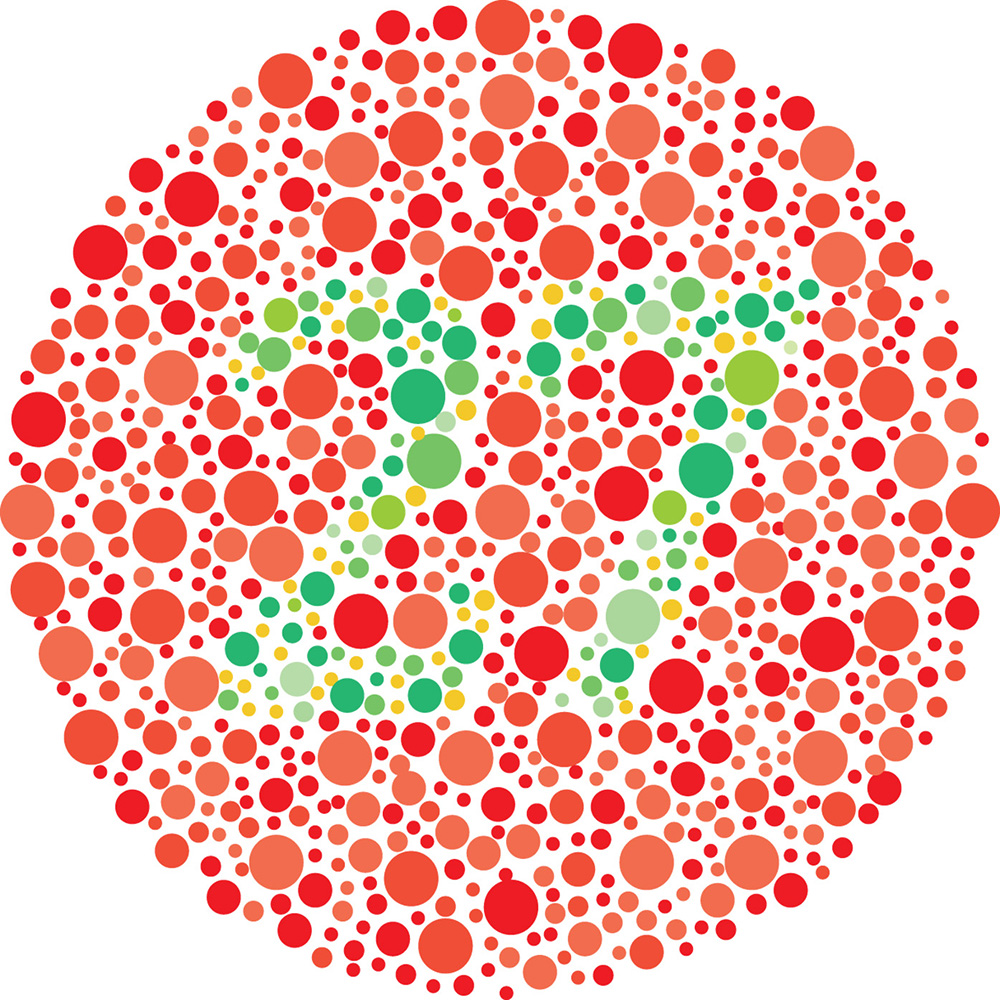
This semester I am taking a visual literacy class. I am excited to learn more about this complicated topic, as I have relatively little background in visuals. I believe that this topic could play a big part in my thesis, but there is one thing that worries me: I am colorblind.
I found out that I was color blind when the third grade. To that point in my life, I didn’t really notice that I was different, nor did I feel like I was ever at a disadvantage. But once I found out that I was “red-green deficient,” the way my eyes process visual images became a big part of my personal and social identity.
In Arthur Asa Berger’s text, “Seeing is Believing,” he states,
“Visual communication is a central aspect of our lives, and much of this communication is done indirectly, through symbolic means: by words and signs and symbols of all kinds. Our emotional states and our creative impulses need some kind of visual and symbolic expression to develop and maintain themselves… (2002)”
It wasn’t until I was in the seventh grade that being moderately color blind actually affected me. I was struggling in school for the first time in my life as I took a visual arts class. I was consistently receiving very low grades because of poor color coordination. At midterms, I had a low C. I explained to my teacher my struggles, but she was understandably skeptical. It wasn’t until I received a note from my optometrist stating that I was actually color blind that I was exempt from being graded down for anything color-related.
After that experience, I visited my optometrist and he gave me a list of professions that I could not pursue because of my colorblindness. The list included: electrician, pilot, plumber, government and military service. That being said, I never felt at a disadvantage in life. It wasn’t until my daughter was born that I felt like I was missing out. Apparently, my oldest daughter has the most beautiful sky blue eyes. It frustrates me that I cannot see and appreciate my daughter’s beauty with the same vividness that the rest of the world sees.
In chapter one of, “Seeing is Believing,” Berger used a quote from Rudolf Arnheim (Visual Thinking, 1969) to explain how we physiologically see. It says:
“Visual perception is not a passive recording of stimulus material but an active concern of the mind. The sense of sight operates selectively. The perception of shape consists in the application of form categories, which can be called visual concepts because of their simplicity and generality. Perception involves problem solving.”
Perception is an active process conditioned by expectations and adapted situations. Because I am colorblind, my perception is affected. The things that I perceive and notice is different from the thing those around me perceive and notice. I can actually look for something all day long, but will never see it.
According to the National Eye Institute, “Color blindness can make it difficult to read color-coded information such as bar graphs and pie charts… Simple everyday tasks like cooking meat to the desired color or selecting ripe produce can be a challenge for adults… Traffic lights pose challenges, since they have to be read by the position of the light… Reading maps or buying clothes that match colors can also be difficult.”
I don’t anticipate my colorblindness to majorly affect me during class this semester. That being said, I am interested to see if this disability gives me a unique perspective from my classmates.
References
Arnheim, R. (1969). Visual Thinking. Ann Arbor: University of Michigan Press.
Berger, A. A. (2002). Seeing is believing: An introduction to visual communication (4th ed.). Mountain View, CA: Mayfield Pub.
National Eye Institute. (n.d.). Facts About Color Blindness. Retrieved January 22, 2016, from https://nei.nih.gov/health/color_blindness/facts_about
 Hayden Coombs
Do you think taking art would be difficult? (I’m also colourblind)
I took a few art classes growing up. As long as I had someone there to tell me which color was which I did okay!
Thanks : )