Gaming and Visual Communication
It’s no secret that one of my favorite pastimes is gaming. My entire life I have enjoyed playing video games. Growing up in the northwest, shooting hoops in the backyard was often not option due to the rain. When the weather wouldn’t permit me to play basketball, I would turn to gaming. With that being said, since starting graduate school, juggling my fatherly duties, and working three jobs, I have not played that much over the past 16 months. However, the fact remains that whenever I am feeling stressed or overwhelmed, often the best way for me to clear my mind is to find a precious few free minutes to get lost in a video game.
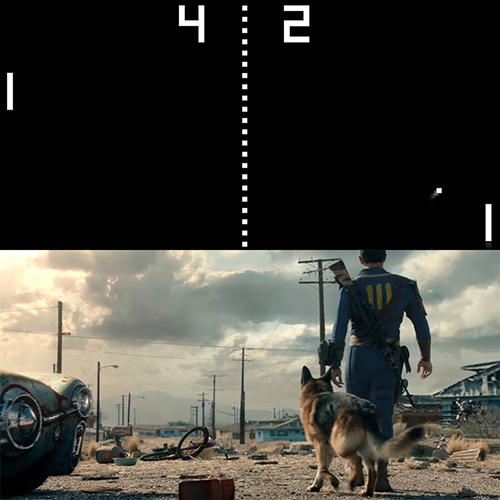
Mainstream commercial video games have been around since the 1970s. In 1972, Pong allowed users to play a version of virtual table tennis, but offered very little in the way of animation or special effects (Berger, 2008). As technology has advanced, however, computers gradually became less expensive and more powerful, which resulted in more people having access to computer games, which in turn were becoming increasingly elaborate and interesting (Berger, 2008). It is amazing to compare a modern game with one of the gaming trailblazers, such as Pong, and see how far the gaming industry has come in just 40 years.
Video games as an art form is a relatively recent conversation. In June of 2011, the Supreme Court ruled that video games should be considered an art form, and were found to be as deserving of First Amendment safeguards as, “the protected books, plays and movies that preceded them” (Sutter, 2011). In March 2012, the Smithsonian American Art Museum opened an exhibition celebrating 40 years of video games as an art. The exhibit, “celebrates 40 years of the genre, from Pac-Man to Minecraft.,” and includes video game screen shots, videotaped interviews with game designers, vintage consoles, and opportunities for visitors to seize the arcade joystick or controls themselves (Tucker, 2012).
The role that video gaming plays in visual communication is constantly evolving. Colin Malone of Southwestern University said,
“Visual images are often used to organize and guide our everyday lives. From road signs to bathroom signs, visual images tell us where we should and should not be or should and should not go. This is not entirely different than how visual images are used in video games: to guide, direct, and communicate with the player. Almost everything in video games has a visual component, which just as much as level design can guide player action and can communicate with the player as much as any amount of dialogue. Things like the title screen, the visual interface of the games, and the visual appearances of the game menus can communicate a great deal about the game itself and how the player is expected to interact with it… by looking at the video game components of the title screen, the HUD, and the game menus we can see how these elements give the player means to understand the world within the game and the means through which they can exercise their agency. They provide both context and frame through which the player can understand the game and the meanings conveyed within” (Malone, 2012).
The single aspect that makes video gaming a unique visual medium is the concept of agency. As a gamer is making conscious decisions inside of the game, the game developers and designers have to consider ever visual choice as an important part of how their users (the gamers) are creating meaning within and outside of the game. Through visual communication, game designers and developers use the games they create to communicate with players and provide a frame of reference with which to understand their games.
References
Berger, A. A. (2008). Seeing is believing: An introduction to visual communication (3rd ed.).Mountain View, CA: Mayfield Pub.
Malone, C. (2012, May 4). Visual Elements Within Games. Retrieved April 14, 2016, from http://people.southwestern.edu/~bednarb/su_netWorks/projects/malone/MaloneEAP3.html
Sutter, J. D. (2011, June 27). Supreme Court sees video games as art. Retrieved April 14, 2016, from http://www.cnn.com/2011/TECH/gaming.gadgets/06/27/supreme.court.video.game.art/
Tucker, A. (2012, March). The Art of Video Games. Retrieved April 14, 2016, from http://www.smithsonianmag.com/arts-culture/the-art-of-video-games-101131359/?no-ist
 Hayden Coombs