How Sports Fans Forge Intergroup Competition Through Language: The Case of Verbal Irony
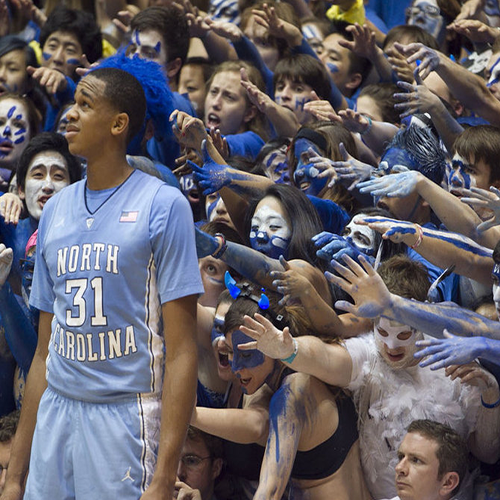
Without a doubt, sports fans are some of the most passionate in the world. Whether it is cheering on their favorite team or athlete, or vehemently rooting against their arch-rivals, sports bring out the best and worst of us all. Speaking from personal experience, as a passionate fan of Duke University Athletics, I know I have chosen to not engage in a friendship/relationship with another person simply because I knew they were fans of the University of North Carolina. It might sound ridiculous, but sports fandom is something that is essential to the very core of many people, myself included.
When specifically observing the language used when conversing about sports, fans frequently use passionately poetic language when speaking about their favorite teams and athletes. Likewise, when conversing about that despised club, sports fans often engage in hurtful, vitriolic banter.
In a 2014 article published in Human Communication Research, Christian Burgers, Camiel Beukeboom, Martinke Kelder, and Martine Peeters of the University of Amsterdam, studied the phenomena of how sports fans forge intergroup competition through language. They found that in situations with rival groups, people strategically use language to strengthen group identity and foster intergroup competition. The researchers distinguished two separate communication mechanisms to accomplish this: (a) linguistic aggression toward out-group members, and (b) communicating group expectancies.
Burgers, et al. contrasted these mechanisms across two experiments by studying verbal irony. The first experiment targeted speaker behavior and showed that Dutch soccer fans found irony more appropriate to comment on out-group (vs. in-group) members, regardless of behavioral valence. The second experiment demonstrated differential inferences from irony by neutral observers: Fans using ironic comments about competent (vs. incompetent) behavior were seen more as out-group and less as in-group members. These experiments demonstrated a communication asymmetry between speaker behavior and addressee inferences.
In their article, the researchers state:
“Many people enthusiastically identify with and support their local sports teams, which can have positive effects on social well-being by increasing social connections (Wann, 2006) and social capital (Palmer &Thompson, 2007). However, fan allegiance can also have negative consequences when promoting out-group derogation and violence between fans of opposing teams (Braun & Vliegenthart, 2008). Linguistic tools such as irony are important elements to communicate and maintain intergroup differences, depending on the positions of speaker and addressee (e.g., enthused fans, neutral observers). This study provides a firm basis for future research that can hopefully further extend our knowledge on the subtleties with which language is used to communicate, accentuate, or mitigate intergroup expectancies and rivalries.”
I found this article to be both informative and entertaining. I always appreciate when researchers can find ways to mix sports and academics. I highly recommend tracking down a copy of this article.
 Hayden Coombs