Module Overview:
In general, news stories are organized using the inverted pyramid style, in which information is presented in descending order of importance. This allows the audience to read the most crucial details quickly so they can decide whether to continue or stop reading the story. From an editing perspective, using the inverted pyramid style makes it easier to cut a story from the bottom, if necessary.
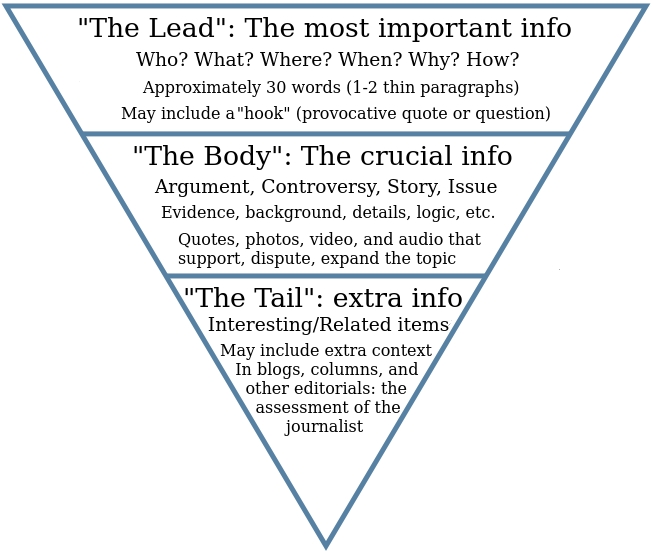
It is important to note that some news stories do not strictly follow the inverted pyramid style, although the lead for a hard news piece always does. Furthermore, not everyone in the journalism field embraces the style; some detractors believe it is an unnatural way to engage in storytelling and present news to the public. Yet, proponents believe it is an efficient way to organize and share information in a fast-paced society. Therefore, it’s important for students to learn the style; one good way to do so is to regularly read hard news stories and pay attention to how the leads are structured. The lead (also known as the summary lead) and the body of the inverted pyramid style are discussed in the next sections.
Module Objectives:
- To learn the purpose and history behind the inverted pyramid.
- To learn how to write in the inverted pyramid style.
For decades, the “inverted pyramid” structure has been a mainstay of traditional mass media writing. Following this structure, the “base” of the pyramid—the most fundamental facts—appear at the top of the story, in the lead paragraph. Non-essential information appears in the following paragraphs, or “nut” graphs, in order of importance.
While some media writers are critical of the inverted pyramid structure, it remains one of the most widely used and time tested structures in mass media writing.
Inverted Pyramid Style
Writing in the Inverted Pyramid style has many benefits for your readers. Everyone who writes for the Web needs to learn to write this way.
What is the Inverted Pyramid?
In journalism, this method of starting with your conclusion is called the Inverted Pyramid style. Sometimes referred to as Front-Loading, it means you should put your most important information first when writing for the web.
This style is called an ‘inverted’ pyramid simply because it is an upside-down pyramid with the most important information at the top.
Why use the inverted pyramid style?
This style of web writing or news story writing has many benefits:
- Readers can quickly assess whether they want to read your entire article.
- Readers can stop reading at any point and still come away with the main point of your article.
- By starting with your conclusion, the first few sentences on your web page will contain most of your relevant keywords, boosting your SEO.
- By front-loading each paragraph, you allow your readers to skim through the first sentences of every paragraph to get a quick overview of your entire article.
Start with your conclusion
Journalists are taught to write news stories using this inverted pyramid structure. They front-load their story, putting the essential and most attention-grabbing elements first, followed by supporting or explanatory information in order of diminishing importance. The least important information is at the bottom.
This style allows newspaper readers to skim their newspapers for a quick news update; they can choose to read only partway through an article knowing that the information they fail to read at the end is not going to be as important as the information at the beginning.
This style also has the advantage of allowing editors to chop off the bottom of articles at any point so that the story will fit into the required space on a newspaper page. When the least important information is at the bottom, articles can be easily shortened by editors without damaging the structure of the story.
Front-loading your content
Front-loading is different to the style you were taught in school or university for essay-writing. To write an essay, you start with an introduction and you gradually build up to your conclusion. To write effectively for the web, you need to do the opposite, and come to the point immediately.
This style calls for a very direct approach. If you spoke in this manner, it would be considered blunt and perhaps a little rude. But it is the preferred style for Internet readers. So be direct. Make your point first, then explain it.
Don’t lose your audience
By front-loading your web content, you are more likely to keep your readers on the page. Today’s Internet users are impatient for results. If they cannot quickly and easily assess your article for points of interest, they are likely to leave your webpage and go search for an alternative that is easier to skim.
How to write in the inverted pyramid style
To Front-load your article:
Write a brief summary or overview of your article in a few sentences. Include your most important keywords in the summary and put it at the beginning of your article. This allows users to quickly assess what your article is about, and helps search engines to identify your most important keywords.
To Front-load every paragraph:
- Limit each paragraph to one main point or idea.
- Start each paragraph with the main point or conclusion in the first one or two sentences.
- Then go on to explain your point.
By doing this, you allow your readers to skim your entire article and get an overview of it by simply reading the first sentence or two of each paragraph. They can also scan your content, looking for points of interest, without having to read every paragraph to the end.
To Front-load your headlines:
Start your headings with significant words. The first words then communicate the subject matter, and catch the eye of your reader. Well-composed headings at the beginning of each section will help your readers to skim and scan the entire article looking for points of interest.
It’s not easy to write in this way
It’s hard for the writer, but easy for the reader.
This method of writing does not come naturally and requires a disciplined approach. When we speak, or tell a story, or write an essay, we do not structure our communication by starting with the conclusion.
If you do not structure your Web articles in this way, you are more likely to lose your audience. People who read on the Internet like to:-
- Quickly assess the subject matter of your article, post or story. This allows them to easily decide whether to continue reading or look elsewhere.
- Skim your article for a quick assessment of the main points.
- Scan your article, looking for a particular point of interest so that they can read a particular section and disregard the rest.
Writing in the Inverted Pyramid style allows your readers to do this, making it easier for them to quickly assess and digest your articles. Internet users are impatient for results, and if they have to read a lot of words before getting to the main point, they are likely to give up and look elsewhere.
The harder the writer works, the easier for the reader.
Exceptions: Where this technique is not suitable
Novels and short stories. You would not apply the Inverted Pyramid structure when writing a novel or short story, where the conclusion belongs at the end of the story. However, if you are promoting a novel or other book online, your promotion should be written in the Inverted Pyramid style. You may not wish to disclose the conclusion of your story, but in your promotion, you should immediately make it clear why the reader should read or purchase your book.
Scientific papers have a distinct structure of their own as expected by the scientific community, and the Inverted Pyramid Style of writing might only be suitable for applying to the paragraphs within each section (making them easier to skim and scan).
Poetry is another exception where this technique should not be applied for the obvious reasons that it might destroy the required structure, impact and beauty of the piece.
Essays. When writing an essay for school, college or university, you are most likely required to structure it to have a beginning, middle and ending – with the conclusion at the end.
Tips for RESTRUCTURING an article which was not written this way
If you find you’ve written a piece that is a long ramble of ideas which popped into your head in no particular order, you may find it challenging to restructure it to fit the Inverted Pyramid model. My suggestions are:-
- Create headings for each of the main points in your piece of writing.
- Cut and paste the content so that everything fits under the appropriate heading.
- Review your headings, and organize them in decreasing order of importance.
- Delete unnecessary headings along with their unnecessary content.
- Add headings for missing information, then expand on them.
- Write a summary or lede for the top of the article
- Break your paragraphs up so that you only have one key point for each paragraph.
- Front-load each paragraph, putting the sentence with the key point at the beginning.
- Trim your article, removing unnecessary words and sentences.
- Do some keyword research to determine the phrases users are likely to search for when searching for your article. Popular search terms may differ from the terminology you have used. Make sure you include the keyword phrases that people are searching on.
Get it right the first time – apply the right structure to your article. In my experience, and that of usability expert Jacob Neilsen, it is more difficult to restructure a piece of writing that is a jumble of meandering thoughts, than it is to write it in the Inverted Pyramid style in the first place.
CRITICISMS
Some in the media critique the inverted pyramid for being artless, and certainly, it is not right for every news story, as it removes a great deal of autonomy from the reporter. Others link inverted pyramid style to the decline in newspaper readership, arguing that, by giving away the ending first, the structure goes against the very fundamentals of narrative. Some scholars have theorized that the inverted pyramid structure might actually be more difficult for readers to understand.
With the emergence of online news writing, the inverted pyramid structure is not as prominent as it once was. In the online format, where editors are no longer bound by column inches, an article’s length is more flexible. Similarly, online journalism is increasingly influenced by the presence of bloggers, who typically eschew traditional news writing structure.
CONCLUSION
The inverted pyramid structure simply means placing the most fundamental information in the lead paragraph of the story, and then arranging the remaining details, from most important to least important, in the following nut graphs. Although there are critics of the inverted pyramid style, it remains a widely used approach to mass media news writing.
 Hayden Coombs